How to Read a Vehicle History Report

Spot Carfax and AutoCheck Red Flags Like a Pro

BUYER'S GUIDE 2025

If you've ever stared at a Carfax or AutoCheck report and felt that knot in your stomach, you're not alone. The used market in the USA moves fast—about 40 million vehicles change hands every year—and the quiet killers often hide in plain sight. Recent analysis linked to NHTSA and Consumer Reports found that 42% of used cars sold had undisclosed issues that only a vehicle history report surfaced. Miss one, and it can cost you thousands.

I learned to treat VHRs like an airline preflight checklist when I was buying for a regional dealership group—fast, methodical, no emotion. The report isn't a crystal ball. It's more like a paper trail with breadcrumbs. Follow them, and you either get peace of mind or a very good reason to walk away.

"The report isn't a crystal ball. It's more like a paper trail with breadcrumbs."

Today we'll read one the way a seasoned buyer does, step by step, with examples that actually feel like car lots in the USA—salt-belt rust, hurricane leftovers, title quirks, the works. By the end, you'll have a process you can run in 10 minutes, whether you're shopping local, at Carvana, or scoping Cars online from three states over.

Step-by-Step Reading Process

Start with the VIN. Pull it from the windshield base or the driver's door jamb. Run a free title snapshot through NMVTIS (mandated under 49 U.S.C. § 32709). Then buy the full reports—Carfax's single report has recently hovered around $44.99, while AutoCheck sells bundles starting near $24.99. I buy both. Carfax draws from over a hundred thousand sources and shines on service data; AutoCheck often catches auction and fleet movements that slip by Carfax. The overlap is your truth window.

Open the report and move in order: title status first, then ownership count and locations, mileage graph, accidents/structural notes, service chronology, and open recalls. Don't skim. Trace the timeline slowly like you're following a map. If the mileage zigzags or stalls for a year, walk—odometer fraud is the quietest $10,000 mistake you'll ever make.

My 10-Minute Reading Routine

  • Run NMVTIS first for a fast title check, then buy Carfax and AutoCheck.
  • Scan the title line for salvage, rebuilt, flood, lemon buyback, or lien notations.
  • Count owners and list their states in order; watch for storm or rust hotspots.
  • Trace mileage on the chart—no dips, no "mystery months," no resets.
  • Read accidents carefully: "structural," "airbag deployed," "tow required," "severe."
  • Skim service for timing belt/chain, transmission service, brake fluid, coolant, battery health (for EVs).
  • Check recalls, then compare the for-sale date to the last service or emission test.
  • Flag anything odd for your mechanic to verify on a lift and with a scan tool.

Titles and owners. A clean title is necessary but not sufficient. You're looking for changes that tell a story: private owner in Ohio, then a wholesale move through Pennsylvania, then a retail listing back in Ohio three weeks later—why the loop? States have different disclosure rigor. Flood season in the Southeast, rust in the Midwest, hail in the Plains. A cross-country hop right after a major storm should make you curious.

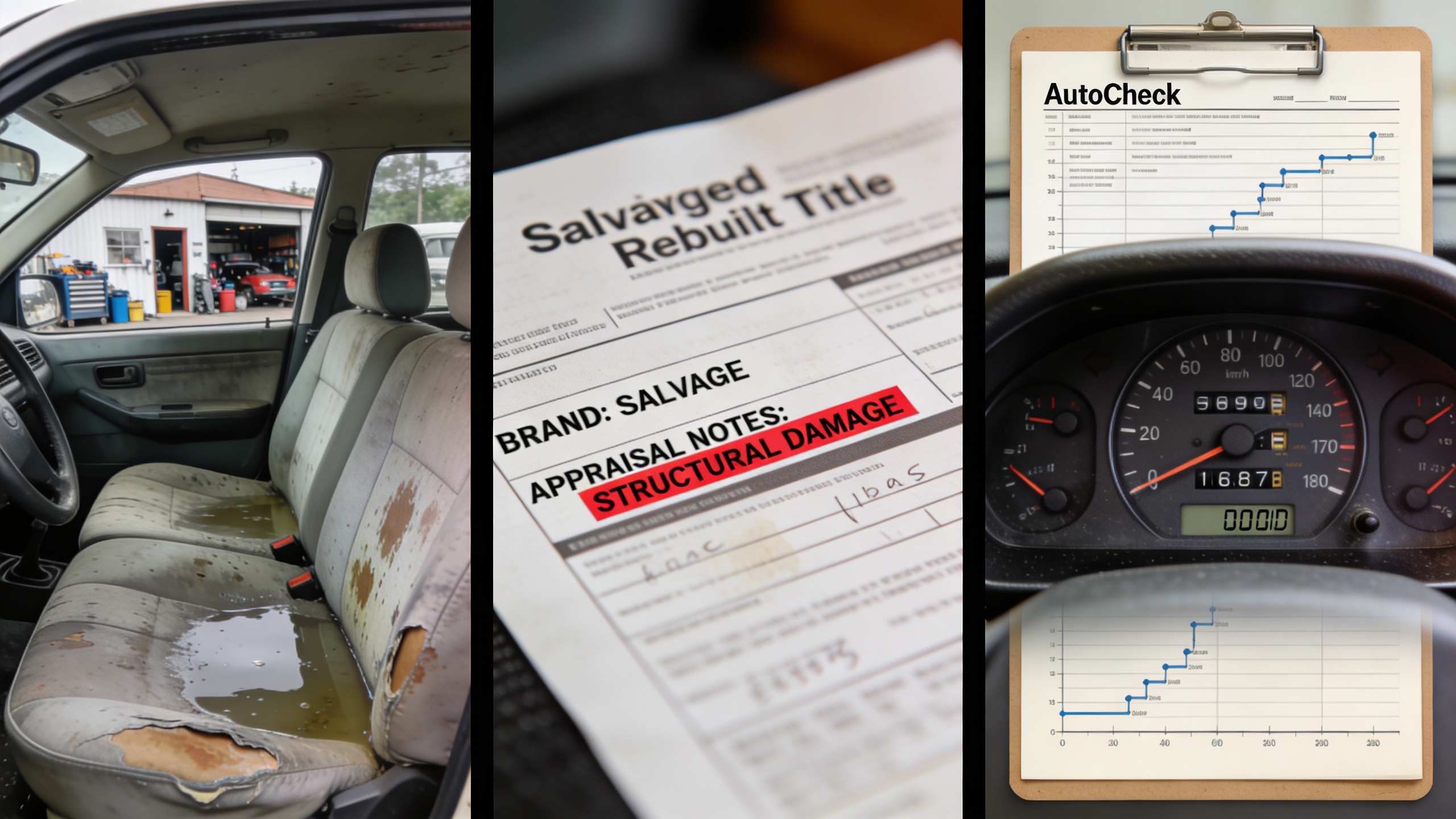
Triptych of water-damaged car interior, a salvaged title document, and an odometer timeline from a report, warning buyers about flood and odometer red flags when buying cars online

Red Flags That Stop You Cold

Accidents and structural damage next. Words matter. "Minor" can be a bumper and paint. "Moderate" suggests parts replacement. "Structural" or "frame" changes the whole deal; even repaired, the geometry of the car—and its resale—takes a hit. If you see "airbag deployed," you're now dealing with potential secondary damage: wiring, sensors, interior replacements. The report won't reveal everything, so you're collecting red flags to verify on a lift.

Flood indicators. After major storms, tens of thousands of waterlogged cars re-enter the market. The USA's coastal states, especially Florida and Texas, see wave after wave of these. Reports may flag "flood," "water damage," or "total loss," yet I've seen clean titles on cars that still smelled like the Gulf. Check for corrosion on seat rails, silt under carpets, foggy headlamp housings, and rust blooming on fasteners inside the cabin. Texas authorities sued multiple sellers in 2025 for hiding flood histories—so document everything and walk if anything feels off.

"Odometer fraud is the quietest $10,000 mistake you'll ever make."

Odometer games. A mismatch of more than 10% between readings should set off alarms. Carfax data suggested about 1 in 11 used cars has an odometer issue. Digital clusters aren't safe from tampering. Look for mismatched wear—shiny pedals with "low" miles, cracked driver seat bolsters at 35,000, fresh steering wheel on a supposedly original-owner car. If you suspect fraud, the NHTSA hotline (1-888-327-4236) exists for a reason.

Hands-On Checks When a Report Smells Fishy

  • Use a paint depth gauge ($40–60) to confirm bodywork honesty.
  • Scan the car with an OBD-II tool; crash and airbag modules tell stories.
  • Lift the trunk liner and cabin carpets—sniff first, then look for silt and surface rust.
  • For EVs, ask for battery health data and thermal event history; the EPA pushed clarity here starting 2024.
  • Get a PPI from an ASE-certified shop; $150–300 saves you four figures.

Liens and repos. NMVTIS finds titles clouded by active loans more often than you'd think—roughly 8% by some recent tallies. Repossessions rose in 2025 as interest rates bit into budgets. A car with a hidden lien can be repossessed from you even though you paid in full. Demand a lien release and verify with your DMV before you wire a cent.

Real-World Buying Scenarios

Buying Cars online from your couch sounds dreamy until the transporter drops a car that doesn't match its photos. Carvana and similar platforms make the process smooth—titles handled, paperwork delivered—but you still need to vet the VHR like you would on a dealer lot. The USA has wild regional variance: a SoCal commuter Civic isn't the same animal as a Michigan winter warrior with salt scars underneath.

Now the sticky part: car auction access for buyers in USA. Most true wholesale auctions are dealer-only. That means retail buyers rarely see the raw lanes where cars are tossed around fast. When you ask how dealers buy cars, the answer is simple—at those dealer-only auctions, often using floorplans (short-term credit lines secured by inventory). Floorplan interest explained in plain English: every day that car sits, it costs the dealer money. So some sellers flip quickly and light on documentation. That churn often shows up in VHRs as back-to-back ownership changes with thin service notes. Read those timelines with a skeptic's eye.

"A clean title isn't a clean bill of health."

Geography matters. The Southeast (Florida, Georgia, the Carolinas) produces twice the flood risk after storm cycles; the Rust Belt (Ohio, Michigan, Pennsylvania) cooks suspension and brake hardware with salt. In 2026, Edmunds estimated average used prices sitting around $27,200, and we also watched EV resales jump—battery health now lives beside oil change records in the must-check column. Don't treat an EV's VHR like a gas car's; battery degradation, charge cycles, and thermal management history matter more than spark plugs ever did.

Three Real Dealership Results

Tampa Buyer: A 2022 Camry looked clean on Carfax but AutoCheck showed flood-salvage lane run. Repairs ate $15,000—legal action recovered most, but stress wasn't free.

California Coupe: "Low miles" and spotless story until service records didn't match odometer. Door jamb sticker looked new on 7-year-old car—part of statewide rollback crackdown.

Texas Truck: Vague VHR about liens, but NMVTIS revealed one remained. Prior dealer's bank still had claws in it. DMV verification before payment would've avoided heartburn.

Remote tactics that work: ask for close-up underbody photos, alignment printouts, and cold-start videos. If a seller stalls, that's your answer. Arrange a PPI near the seller; mobile inspectors exist in most metro areas now. If the report shows minor issues, negotiate 10–20% off or ask for repairs before shipping. If it reeks of drama, save your bandwidth and move on.

Your Final Checklist

  1. Run NMVTIS for a title snapshot before you spend a dime.
  2. Buy both Carfax and AutoCheck; print or save them side by side.
  3. Circle red flags: salvage/rebuilt, flood, structural, odometer mismatch, lemon buyback, lien.
  4. Book an independent PPI ($150–300) and request a scan report plus underbody photos.
  5. Use issues to negotiate 10–20% down or repairs in writing; or just walk.
  6. Report fraud to the FTC and NHTSA if a seller plays games—paper trails matter.

A clean title isn't a clean bill of health; compare the state-by-state timeline and ask what each jump was hiding. If you remember nothing else, remember this: the story on the page should match the wear on the car and the logic of its moves. When it doesn't, trust your gut and your process. You're not buying a story—you're buying steel, safety, and years of calm commutes across the USA.