Ownership Experience: Reliability & Daily Use
EV drivetrains are simple: one or two motors, a big battery, and far fewer moving parts. That simplicity pays off in reliability statistics for the powertrain. Where owners encounter friction is software and electronics integration, which can be brilliant—or finicky—depending on the brand. Hybrids, time-tested and refined, post excellent reliability, especially from automakers with decades of hybrid experience. Gas vehicles remain workhorses, and independent shop networks are universal across the USA, which still matters in rural towns.
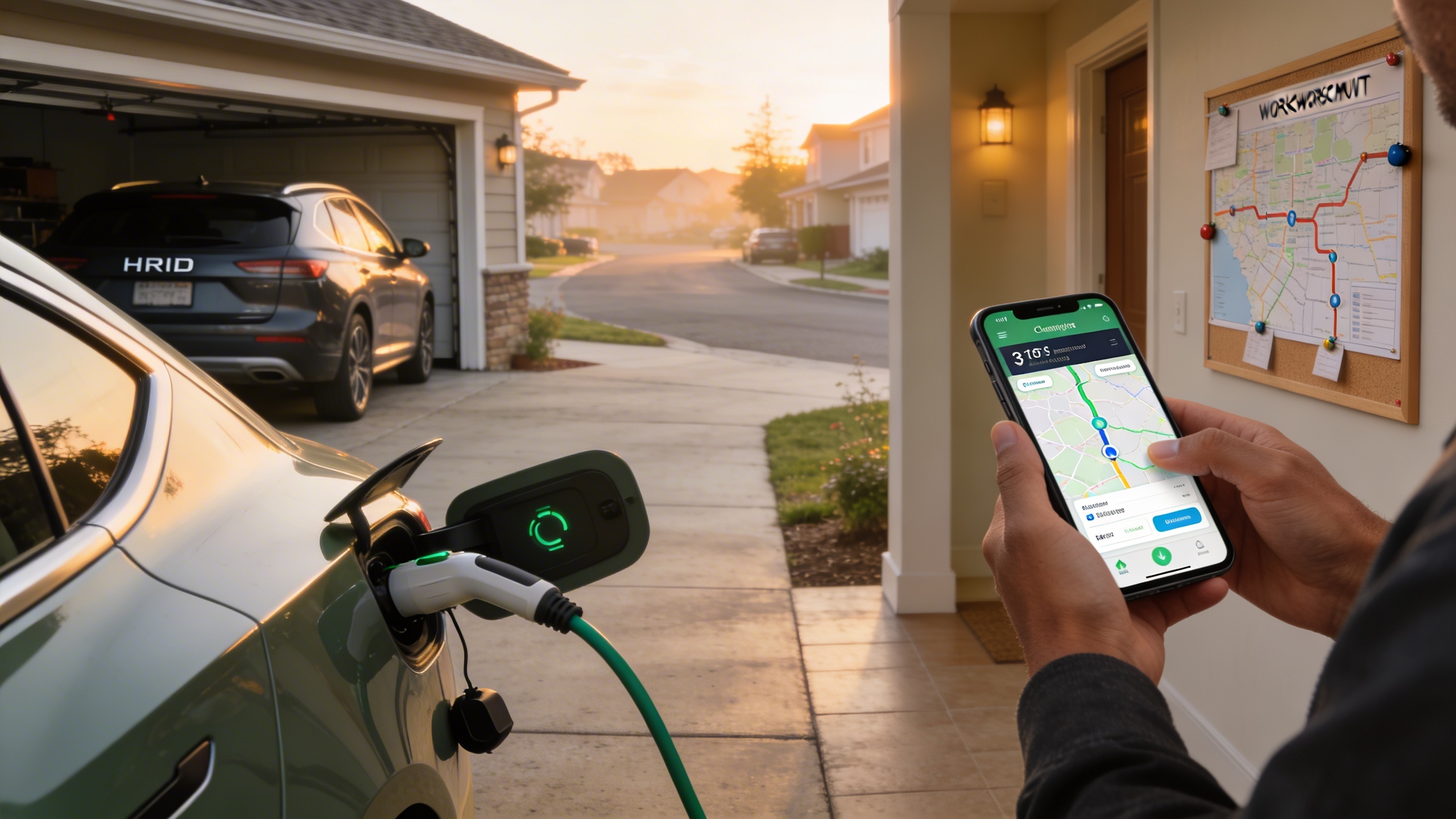
Charging behavior is habit-forming, in a good way. Level 2 charging at home (240V) replenishes 25–40 miles of range per hour, so most drivers plug in and forget it. Road trips rely on DC fast charging: 10–80% in 20–40 minutes for many newer models. Fast enough for coffee, not as fast as a five-minute fuel stop—manage expectations and route planning, and it works. If that cadence bothers you, a hybrid restores the five-minute refuel reality with substantial fuel savings.
Decision Framework Checklist
- Charging reality: Do you have a garage or driveway with 240V access, or reliable workplace charging?
- Commute pattern: Under 60 miles per day with occasional road trips favors EV; unpredictable multi-state weeks favor hybrid or gas.
- Climate: Extreme cold suggests a buffer—bigger EV pack, heat pump, or hybrid.
- Housing: Renters without on-site charging often thrive with hybrids or PHEVs.
- Towing/loads: Frequent heavy towing tilts toward gas or hybrid trucks.
- Local rates: Check your utility's overnight rates and local gas prices.
How Buyers Are Actually Buying
Behind the showroom, the USA market is shifting how inventory moves. Corporate fleet vehicle sales are increasingly directed to buyers seeking predictable maintenance histories and well-documented usage. Rental agencies are rotating out hybrid and electric units more frequently as they balance utilization and residual values, opening avenues for consumers to buy rental fleet vehicles at wholesale-like prices through curated channels.
Platforms that aggregate fleet vehicles for sale wholesale and enable car auction access for buyers in USA have made once-insider-only lanes accessible. VirtualCarHub.com is one example—buyers can preview condition reports, compare lifetime cost projections, and line up car delivery to home. For the shopper weighing hybrid versus EV, that wholesale pipeline can be decisive: the delta between MSRP and auction hammer price sometimes pays for a home charger or erases an interest-rate bump.
"Start with three facts: where you park, how you drive, and what you haul. Everything else follows."
Numbers That Move the Needle
Let's stitch the metrics together. A 13,500-mile annual driver over five years will spend roughly $7,875 on fuel in a 30-mpg gas car at $3.50/gal, $4,725 in a 50-mpg hybrid, and about $3,275 in an EV at $0.16/kWh and 3.3 mi/kWh. Swing electricity to $0.22 and EV fuel spend nudges to ~$4,525; drop it to $0.12 overnight and it falls near $2,450. Tires and insurance can add variance of $500–$1,200 over the window regardless of powertrain, depending on brand and wheel size.
Maintenance deltas across five years: EVs commonly save $800–$1,200 versus peers due to no oil changes and less brake wear. Hybrids shave $400–$900 vs gas, aided by regenerative braking and optimized engine cycling. Battery warranties (often 8 years/100,000 miles in the USA, longer in California emissions states) add a safety net that used-car shoppers value.
Infrastructure is compounding. The USA added thousands of public DC fast-charging ports in 2025, with federal corridor funding accelerating in 2026. Urban reliability is improving as operators standardize connectors and uptime reporting. Rural nodes remain work in progress—plan, and you're fine. Don't plan, and you'll have stories.