The True Cost of Car Ownership

Every Dollar Beyond the Sticker Price

WINTER 2025

What "Out the Door Price" Leaves Out

The price on the window whispers affordability. The monthly payment your lender quotes feels manageable. Then the year rolls on, and the bills stack higher than you planned. Across the USA, AAA pegs the average annual cost to own and operate a new vehicle at $12,182 in 2025, up sharply from 2024. That's not a rounding error; that's a second rent check in some cities, or a chunk of a college fund quietly evaporating in the background.

Most shoppers fixate on the "out the door price" — taxes, title, registration, doc fees — and call it a victory. It's a useful benchmark, no doubt. But the out the door price car in USA transactions doesn't include insurance swings, maintenance creep, fuel volatility, depreciation shocks, and the financing drag created by high interest rates. Those line items don't show up at closing. They show up for years.

"Depreciation is the silent killer—bigger than fuel, louder than insurance, and it hits your wallet the moment you turn the key."

Consider the common scenario: buy a $40,000 crossover and finance it near the market's average rate (around 7% in 2025). You're not just buying a vehicle; you're buying a five-year commitment that can easily approach $60,000 when you tally interest, insurance, fuel, maintenance, and the value you'll lose when you sell. Edmunds analysts warn that depreciation alone can dwarf fuel spend. And they're right.

The first-year hit often lands between 20% and 30%, with some trims sliding faster than others based on incentives, supply, and model-year changes. Ask anyone who took delivery in a hot market, then watched values normalize. It stings.

Transparency in Action

Some platforms are starting to make lifetime costs visible at checkout. VirtualCarHub.com, Like pairs an out-the-door quote with a live five-year ownership estimate based on your ZIP code, commute, and financing profile. Pair that with an online car purchase delivered to your driveway, and the total picture snaps into focus before you sign — not after.

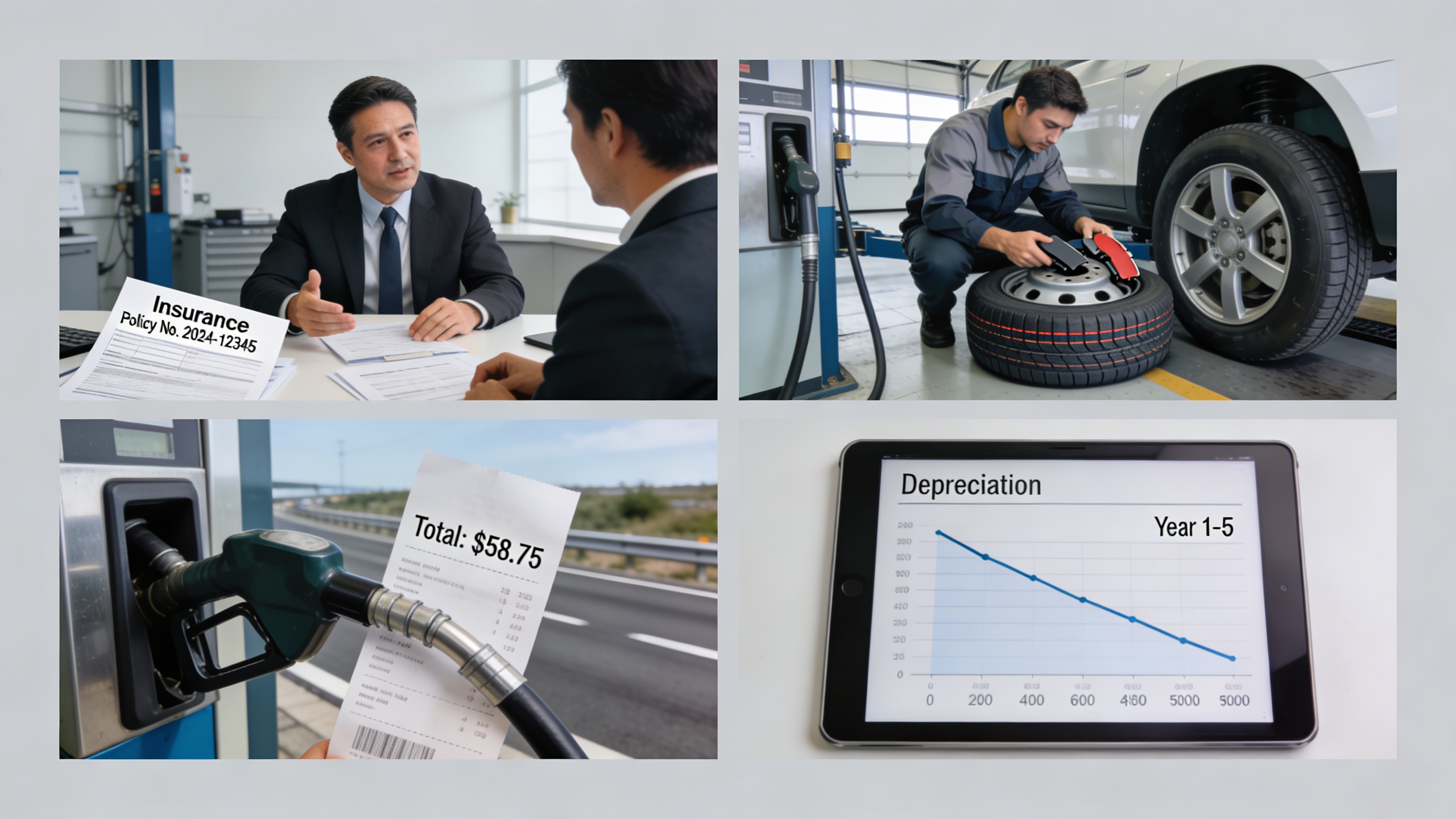
Editorial composite showing insurance discussion, mechanic checking tires, fuel receipt at a pump, and a depreciation graph illustrating the major costs drivers face beyond sticker price

The Big Four Costs

AAA's 2025 data shows what actually empties accounts. Depreciation dominates at roughly 45.6% of the total cost for a new car. Fuel averages about 16.6%. Insurance, 15.5%. Maintenance and tires, 8.9%. Finance charges fill in much of the rest. The composition shifts by model and region, but the song stays the same: the big four do the heavy lifting on your budget.

Insurance: a volatile line item

Insurance is having a moment — and not in a good way. The Insurance Information Institute puts 2025's average annual premium at roughly $2,543, with full coverage around $3,209. Some states are in a different universe. Michigan sits north of $5,000 per year thanks to its no-fault medical rules; Louisiana trails close behind. More frequent and severe weather events spike claims. Car theft cycles add pressure. Telematics can soften the blow (discounts up to 30% are real), but trade-offs exist — your driving data becomes an open book.

Fuel: prices swing, efficiency cushions

With gas floating around $3.45 a gallon nationally and the average driver covering about 14,479 miles a year, a 25 MPG sedan spends roughly $1,482 on fuel, give or take regional swings (California refineries, anyone?). Electric vehicles change the calculus: many households save about $1,000 per year on "fuel" versus gas, but add $499–$600 in home charging hardware and higher tire wear.

"The sticker is the start, not the story."

Maintenance and repairs don't shout at purchase; they whisper later. Post-warranty, owners routinely see $1,000–$1,about 500 per year, according to Kelley Blue Book. Brake jobs near $800 are common. A set of tires for an SUV can flirt with $1,000 — more if your wheels are oversized. ADAS sensor calibrations after a windshield replacement? That can add hundreds.

Depreciation is where wealth goes to disappear. New cars typically surrender 20–30% of their value in year one. Over five years, the average drop crosses $28,000 for mainstream models. Electric vehicles complicate the picture: some trims, like certain Model 3s, have historically held value better than rivals, while used EVs overall saw sharp price swings in 2025 as incentives and supply shifted.

Regional reality check

Location magnifies everything. Sun Belt heat stresses batteries and AC systems, lifting maintenance and energy use. Rust Belt winters and road salt add corrosion-driven repairs (brake lines, exhausts, subframes) that a Phoenix commuter rarely sees. Hail belts across the Plains pepper roofs and hoods, inflating comprehensive claims. Coastal flood zones rewrite insurance math overnight.

Dealership staff showing a couple a five-year total cost dashboard that combines insurer and maintenance data illustrating transparent online car purchase delivered options

Finding the Best Car Deals Online

Price-hunting still matters, but the smartest shoppers fix the total cost first. Chasing the "Best car deals" while ignoring insurance bands, depreciation curves, and APR is like booking the cheapest flight and forgetting about baggage fees. If you're exploring a Carvana alternative or a CarMax alternative, look for two things: a verified out-the-door quote and a transparent ownership forecast tied to your region.

Your loan structure matters as much as the vehicle. Stretching from 60 to 84 months drops the monthly number while adding thousands in interest. With rates around 7% in 2025, a $40,000 loan over 60 months costs roughly $7,500–$8,000 in interest; at 84 months, you can tack on several thousand more — and risk being upside down longer.

  • Get a real out-the-door quote broken out by taxes, title, registration, and doc fees — then add a five-year TCO model before negotiating.
  • Pull an insurance quote for the exact VIN and your address; switching vehicles changes garaging factors and safety discounts.
  • Price tires and routine services for your wheel size and drivetrain; 20-inch performance rubber isn't priced like 17-inch touring tires.
  • Compare APRs across three lenders on the same day; rate locks slip fast in volatile markets.
  • Ask for historical depreciation curves from trusted sources; avoid trims with incentive-driven value cliffs.
  • If buying an EV, include home charger hardware, installation, and peak electricity rates — plus road-trip fast-charging premiums.

Real Dealership Results

Transparency sells because it protects the buyer from surprise costs. A midwestern retailer that piloted a TCO-first checkout using a mix of insurer APIs and local maintenance estimates saw shoppers spend more time on five-year cost screens than on photo galleries. Conversion rose. Cancellations fell. When they layered in an out-the-door calculator with ZIP-based taxes and a delivery scheduler — the kind that turns an online car purchase delivered into a specific Tuesday at 10 a.m. — call volume dropped and trust metrics climbed.

"Run the numbers for your ZIP, commute, and credit profile before you fall in love with a badge."

The road ahead isn't cheaper. AAA projects ownership costs to keep rising toward $14,000 per year by decade's end, driven by pricier repairs, volatile insurance, and software subscriptions creeping into the monthly stack. Some metro areas may see relief from shared fleets and autonomous pilots; others will double down on driveway ownership. Either way, the rule holds in the USA: the sticker is the start, not the story. Run the numbers for your ZIP, commute, and credit profile before you fall in love with a badge. Then make the deal that wins the next five years — not just the afternoon at the showroom.